


The Intelligent Network: A Deep Dive into the Global AI in Telecommunication Industry
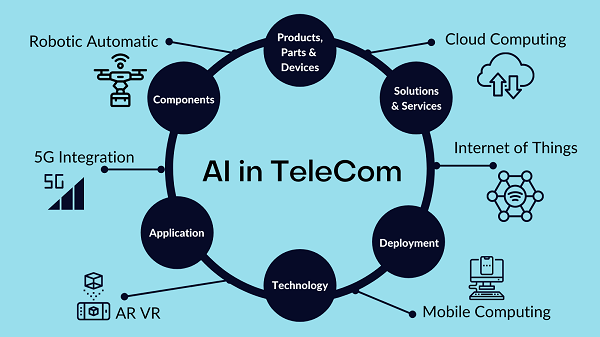
The telecommunications industry, the foundational infrastructure of our connected world, is undergoing a profound and complex transformation. At the very heart of this evolution is the rapidly accelerating AI in Telecommunication industry, a sector dedicated to embedding artificial intelligence and machine learning into every facet of network operations, customer service, and business strategy. In an industry facing immense pressure from stagnant revenues, escalating network complexity, and soaring customer expectations, AI is no longer a futuristic concept but a critical tool for survival and growth. This industry is focused on leveraging AI to move from manual, reactive processes to automated, proactive, and even predictive operations. It encompasses a wide range of applications, from using machine learning to predict network faults before they occur and dynamically optimizing radio access networks, to deploying AI-powered chatbots that can resolve customer issues instantly. AI is becoming the "brain" of the modern telecom network, enabling a level of efficiency, agility, and intelligence that is essential for managing the demands of the 5G era and beyond.
The core applications of AI in the telecommunication industry can be broadly categorized into three main domains: network operations, customer experience management, and fraud prevention. In network operations, AI is a game-changer. Telecom networks are some of the most complex systems ever built, generating a torrent of performance data every second. AI and machine learning algorithms can analyze this vast dataset to perform predictive maintenance on network equipment, forecasting component failures and allowing operators to schedule repairs before an outage occurs. AI is also critical for network optimization, dynamically adjusting network parameters in real-time to manage traffic congestion, optimize signal quality, and reduce energy consumption. This "self-optimizing network" (SON) capability is crucial for managing the complexity of 5G networks. For customer experience, AI is being used to power intelligent chatbots and virtual assistants that can handle a large volume of customer queries 24/7, from billing questions to technical support, freeing up human agents for more complex issues. AI also analyzes customer data to predict churn, allowing carriers to proactively offer targeted promotions to at-risk customers.
The technological foundation of AI in telecommunication is a powerful combination of big data, machine learning, and scalable cloud infrastructure. The telecom industry is a massive generator of data, including network performance data, call detail records (CDRs), and customer interaction data. This rich dataset is the essential fuel for any AI application. The industry is leveraging a wide range of machine learning techniques. Supervised learning is used to build predictive models, such as predicting customer churn based on historical data. Unsupervised learning is used for anomaly detection, identifying unusual patterns in network traffic that could indicate a security threat or an emerging fault. Reinforcement learning is being explored for complex, real-time network optimization tasks, where an AI agent can learn through trial and error to find the optimal network configuration. The deployment of these AI models is increasingly happening on cloud platforms, which provide the scalable compute power needed to train complex models and the flexibility to deploy AI-powered services across the network.
The ecosystem of the AI in telecommunication industry is a diverse mix of players. It includes the major Communication Service Providers (CSPs) themselves, who are building their own in-house AI and data science teams to develop custom solutions. It features the traditional network equipment providers, like Ericsson, Nokia, and Huawei, who are embedding AI capabilities directly into their hardware and network management software. A major and growing segment is the large enterprise software and cloud providers, such as IBM, Microsoft, and Google, who are offering their powerful AI platforms and tools to the telecom industry. Finally, there is a vibrant ecosystem of specialized AI startups that are developing point solutions for specific telecom challenges, such as AI-powered fraud detection or network analytics. This dynamic interplay between telcos, equipment vendors, cloud giants, and agile startups is driving a rapid cycle of innovation, making AI an indispensable component of the modern telecommunications landscape.
Top Trending Reports:

 English
 Arabic
 French
 Spanish
 Portuguese
 Deutsch
 Turkish
 Dutch
Dutch
 Italiano
 Russian
 Romaian
 Portuguese (Brazil)