• Explore more : https://hrtechcube.com/payroll-automation-software-that-saves-time-and-reduces-compliance-risk/


    Payroll Automation Software Reinventing HR Processes in Today's World Automating Salary Payments to Reduce Errors and Increase Compliance HR payroll is a complex process that
    requires precision. Automation can streamline HR work, minimize errors and secure sensitive data, allowing HR teams to save time on administrative processes.
    Find out how the integration of HR software is creating the ideal payroll workflow and what you need to know. Check out the latest ai tech news, ai tech trends
    and ai technology news. Read more on HrTech Cube.


    #HRtechnology #HRTech #HrTechCube
    Explore more : https://hrtechcube.com/payroll-automation-software-that-saves-time-and-reduces-compliance-risk/ Payroll Automation Software Reinventing HR Processes in Today's World Automating Salary Payments to Reduce Errors and Increase Compliance HR payroll is a complex process that requires precision. Automation can streamline HR work, minimize errors and secure sensitive data, allowing HR teams to save time on administrative processes. Find out how the integration of HR software is creating the ideal payroll workflow and what you need to know. Check out the latest ai tech news, ai tech trends and ai technology news. Read more on HrTech Cube. #HRtechnology #HRTech #HrTechCube
    0 Commentarios 0 Veces compartido 299 Visualizaciones
  • Explore more : https://hrtechcube.com/unified-hr-platforms/


    Unified HR Platforms is destroying separate employee records and unlinked HR systems. See how a single source of truth or shared technologies integrated with payroll,
    recruiting, time and attendance, performance management, and employee data increase data integrity, reduce inefficiencies, and take the pain out of HR. Keep up to date
    with the latest HR news from around the world and Human Resource Current Updates from HrTech Cube. Find out how effective new HR technology drives you
    a stronger workforce, greater insight, and smarter decisions.
    Explore more : https://hrtechcube.com/unified-hr-platforms/ Unified HR Platforms is destroying separate employee records and unlinked HR systems. See how a single source of truth or shared technologies integrated with payroll, recruiting, time and attendance, performance management, and employee data increase data integrity, reduce inefficiencies, and take the pain out of HR. Keep up to date with the latest HR news from around the world and Human Resource Current Updates from HrTech Cube. Find out how effective new HR technology drives you a stronger workforce, greater insight, and smarter decisions.
    0 Commentarios 0 Veces compartido 686 Visualizaciones
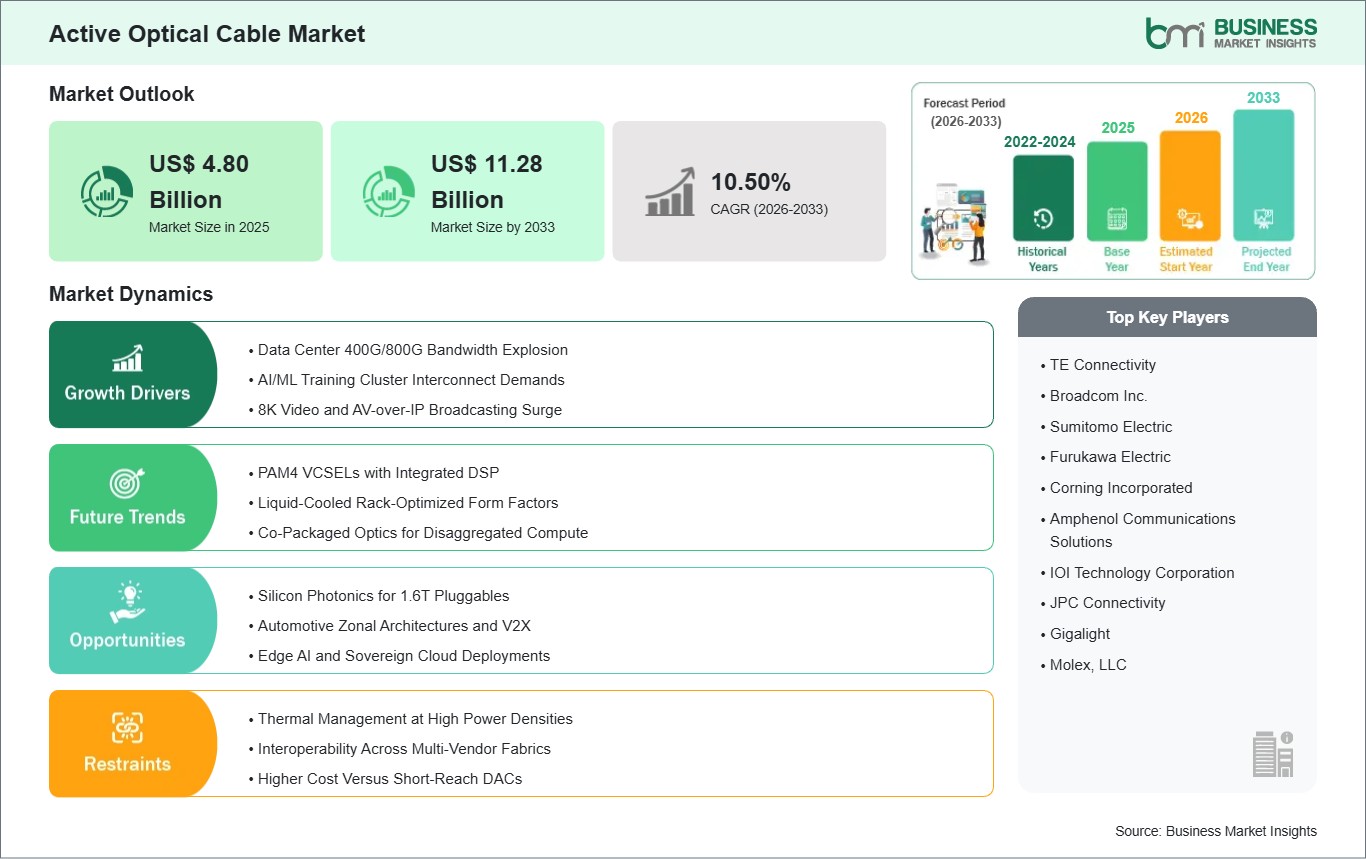
  • Active Optical Cable Market Projected for US$ 11.28 Billion Revenue by 2033


    The Active Optical Cable Market was valued at US$ 4.80 Billion in 2025 and is projected to reach US$ 11.28 Billion by 2033, registering a CAGR of 11.27% during 2026–2033.


    The outlook combines expanding addressable demand with a need for disciplined execution across products, regions and channels.


    What is driving the market?


    The core growth engine is digitalization; higher data and computing requirements; connected-device adoption; semiconductor and sensor innovation; automation and software integration. These forces expand demand because they change operating priorities and increase the value of solutions that improve performance, access, safety, efficiency or control. At the same time, the market is not frictionless: rapid technology cycles; interoperability and cybersecurity; qualification complexity; component supply risk; pricing pressure. Suppliers that convert the strongest drivers into measurable customer outcomes while reducing adoption friction should be better positioned to capture the forecast expansion.


    https://www.businessmarketinsights.com/reports/active-optical-cable-market
    Active Optical Cable Market Projected for US$ 11.28 Billion Revenue by 2033 The Active Optical Cable Market was valued at US$ 4.80 Billion in 2025 and is projected to reach US$ 11.28 Billion by 2033, registering a CAGR of 11.27% during 2026–2033. The outlook combines expanding addressable demand with a need for disciplined execution across products, regions and channels. What is driving the market? The core growth engine is digitalization; higher data and computing requirements; connected-device adoption; semiconductor and sensor innovation; automation and software integration. These forces expand demand because they change operating priorities and increase the value of solutions that improve performance, access, safety, efficiency or control. At the same time, the market is not frictionless: rapid technology cycles; interoperability and cybersecurity; qualification complexity; component supply risk; pricing pressure. Suppliers that convert the strongest drivers into measurable customer outcomes while reducing adoption friction should be better positioned to capture the forecast expansion. https://www.businessmarketinsights.com/reports/active-optical-cable-market
    WWW.BUSINESSMARKETINSIGHTS.COM
    Active Optical Cable Market Share, Size & Demand by 2033
    Active Optical Cable market is expected to surpass US$ 11.28 billion by 2033, growing at a CAGR of 11.27%. Explore growth insights & forecast.
    0 Commentarios 0 Veces compartido 1K Visualizaciones
  • Global GaN RF Front End Market to Reach USD 8,767.49 Million by 2034 as 5G, Satellite Communications and Radar Applications Accelerate Demand
    The global telecommunications and defense industries are increasing their reliance on high-performance radio frequency components as wireless networks, satellite links and radar platforms demand higher output power, wider bandwidth and improved energy efficiency. Against this backdrop, gallium nitride (GaN) RF front-end technology is gaining importance because of its high power density, reliability and ability to support demanding high-frequency applications.
    According to Semiconductor Insight, the Global GaN RF Front End Market was valued at USD 1,699.20 million in 2025 and is estimated at USD 2,039.04 million in 2026. The market is projected to reach USD 8,767.49 million by 2034, growing at a CAGR of 20.0% during 2026–2034. GaN RF front-end products include discrete RF power transistors, microwave integrated circuits, qualified amplifier stages and integrated RF power modules used in cellular radio access, satellite communications and radar systems.
    Explore the complete market analysis
    Why Are GaN RF Front Ends Becoming Important in Advanced Wireless Systems?
    RF front-end components play a critical role between baseband or exciter electronics and antennas, where signal amplification, linearity and thermal performance influence the quality and efficiency of wireless transmission. As communication systems move toward higher frequencies and more complex radio architectures, manufacturers require components capable of sustaining high RF output under demanding operating conditions.
    GaN high-electron-mobility transistors use wide-bandgap material properties and high electric-field capability to deliver greater power density than conventional silicon devices in selected RF applications. This can reduce the number of parallel amplifier paths and provide greater flexibility in radio-frequency matching networks.
    These characteristics are particularly relevant to 5G radio access networks, satellite communication payloads and radar equipment.


    Semiconductor Insight is a leading provider of market intelligence and strategic consulting for the global semiconductor and high technology industries. Our in-depth reports and analysis offer actionable insights to help businesses navigate complex market dynamics, identify growth opportunities, and make informed decisions. We are committed to delivering high quality, data driven research to our clients worldwide.
    🌐 Website:Semiconductorinsight
    📞 Asia Number: +91 8087 99 2013
    🔗 LinkedIn: Follow Us
    Semiconductor Etch Equipment Market 2026
    Semiconductor etch equipment market reaches approximately USD 30,679 million in 2034, equivalent to a 4.9% CAGR for 2026–2034
    Global GaN RF Front End Market to Reach USD 8,767.49 Million by 2034 as 5G, Satellite Communications and Radar Applications Accelerate Demand The global telecommunications and defense industries are increasing their reliance on high-performance radio frequency components as wireless networks, satellite links and radar platforms demand higher output power, wider bandwidth and improved energy efficiency. Against this backdrop, gallium nitride (GaN) RF front-end technology is gaining importance because of its high power density, reliability and ability to support demanding high-frequency applications. According to Semiconductor Insight, the Global GaN RF Front End Market was valued at USD 1,699.20 million in 2025 and is estimated at USD 2,039.04 million in 2026. The market is projected to reach USD 8,767.49 million by 2034, growing at a CAGR of 20.0% during 2026–2034. GaN RF front-end products include discrete RF power transistors, microwave integrated circuits, qualified amplifier stages and integrated RF power modules used in cellular radio access, satellite communications and radar systems. Explore the complete market analysis Why Are GaN RF Front Ends Becoming Important in Advanced Wireless Systems? RF front-end components play a critical role between baseband or exciter electronics and antennas, where signal amplification, linearity and thermal performance influence the quality and efficiency of wireless transmission. As communication systems move toward higher frequencies and more complex radio architectures, manufacturers require components capable of sustaining high RF output under demanding operating conditions. GaN high-electron-mobility transistors use wide-bandgap material properties and high electric-field capability to deliver greater power density than conventional silicon devices in selected RF applications. This can reduce the number of parallel amplifier paths and provide greater flexibility in radio-frequency matching networks. These characteristics are particularly relevant to 5G radio access networks, satellite communication payloads and radar equipment. Semiconductor Insight is a leading provider of market intelligence and strategic consulting for the global semiconductor and high technology industries. Our in-depth reports and analysis offer actionable insights to help businesses navigate complex market dynamics, identify growth opportunities, and make informed decisions. We are committed to delivering high quality, data driven research to our clients worldwide. 🌐 Website:Semiconductorinsight 📞 Asia Number: +91 8087 99 2013 🔗 LinkedIn: Follow Us Semiconductor Etch Equipment Market 2026 Semiconductor etch equipment market reaches approximately USD 30,679 million in 2034, equivalent to a 4.9% CAGR for 2026–2034
    0 Commentarios 0 Veces compartido 1K Visualizaciones
  • Acoustic Microscopy Market Sustains 5.74% CAGR Amid Rising Demand for Delamination and Crack Detection


    The Acoustic Microscopy Market was valued at US$ 2.22 Billion in 2025 and is projected to reach US$ 3.47 Billion by 2033, registering a CAGR of 5.74% during 2026–2033.
    For executive teams, the forecast matters less as a headline than as a signal to decide where the business can build defendable positions and repeatable economics.


    Browse Full Report: https://www.businessmarketinsights.com/reports/acoustic-microscopy-market


    What is driving the market?
    Strategically, demand is being pulled by digitalization; higher data and computing requirements; connected-device adoption; semiconductor and sensor innovation; automation and software integration. For management teams, these drivers matter because they influence budget ownership, buying urgency and the parts of the value chain where differentiation can be sustained. The principal constraints are rapid technology cycles; interoperability and cybersecurity; qualification complexity; component supply risk; pricing pressure. That makes disciplined portfolio selection and proof of customer value more important than pursuing every application simply because the overall market is growing.
    Which region leads?
    Regional leadership should be interpreted from the source, not assumed. Not publicly disclosed in the retrieved public BMI excerpt; no numerical share is inferred.. Not publicly disclosed in the retrieved public BMI excerpt; no numerical CAGR is inferred.. For executive planning, this means market entry should be sequenced around addressable customer clusters, local partners and the cost of serving each geography; the absence of a public percentage is a reason for diligence, not a reason to invent precision.
    Which segment leads?
    The segment view is The BMI report covers multiple product, technology, application and/or end-use categories; no numerical leading-segment share is publicly disclosed in the retrieved excerpt, so no ranking is inferred.. For strategy teams, the priority is to understand why these categories attract spending and whether the company can build a defendable proposition around them. BMI’s public excerpt is used as the factual limit; no unstated share is calculated or inferred.


    Download the Sample PDF: https://www.businessmarketinsights.com/sample/BMIPUB00033255


    Which companies are prominent?
    BMI’s competitive coverage includes The public BMI excerpt reviewed for this batch does not reliably expose a complete company-profile list; no unverified company names are added..
    What is changing in 2026?
    The 2026 strategic agenda is anchored in the source-backed development context: BMI’s public page does not disclose a specific completed 2026 company announcement in the retrieved excerpt; the 2026 assessment therefore focuses on the source-backed market trajectory and commercialization context without inventing events.. Management teams should translate this into product road maps, partnership priorities and execution milestones instead of treating the forecast as an automatic outcome.
    What are the major investment opportunities?
    Executive priority should be given to next-generation devices; edge and AI integration; data-center and connectivity infrastructure; embedded software; high-performance components. These opportunities can support growth when they fit the company’s capabilities, channel access and risk tolerance. The objective should be to build repeatable positions with clear customer value rather than spreading investment thinly across every possible application.
    Explore the Acoustic Microscopy Market Snippet for a concise overview of the market landscape, evolving business applications, and key market trends shaping adoption across industries and regions. Understand the growth drivers and industry dynamics influencing market development and competitive positioning. Identify emerging opportunities and gain actionable insights to support strategic planning and informed decision-making.
    Related Reading / Reports
    • Acoustic Wave Sensor Market — The topic is directly relevant because it addresses a connected application, component or commercialization pathway.
    • 3D Machine Vision Market — This related market helps frame supplier, customer or technology dependencies that influence the primary market.
    • 3D Projector Market — The report provides complementary context on an adjacent product or end-use area with clear commercial overlap.
    • 3D Camera Market — This report covers an adjacent market with shared technology, end-use or value-chain drivers relevant to the primary market.

    Acoustic Microscopy Market Sustains 5.74% CAGR Amid Rising Demand for Delamination and Crack Detection The Acoustic Microscopy Market was valued at US$ 2.22 Billion in 2025 and is projected to reach US$ 3.47 Billion by 2033, registering a CAGR of 5.74% during 2026–2033. For executive teams, the forecast matters less as a headline than as a signal to decide where the business can build defendable positions and repeatable economics. Browse Full Report: https://www.businessmarketinsights.com/reports/acoustic-microscopy-market What is driving the market? Strategically, demand is being pulled by digitalization; higher data and computing requirements; connected-device adoption; semiconductor and sensor innovation; automation and software integration. For management teams, these drivers matter because they influence budget ownership, buying urgency and the parts of the value chain where differentiation can be sustained. The principal constraints are rapid technology cycles; interoperability and cybersecurity; qualification complexity; component supply risk; pricing pressure. That makes disciplined portfolio selection and proof of customer value more important than pursuing every application simply because the overall market is growing. Which region leads? Regional leadership should be interpreted from the source, not assumed. Not publicly disclosed in the retrieved public BMI excerpt; no numerical share is inferred.. Not publicly disclosed in the retrieved public BMI excerpt; no numerical CAGR is inferred.. For executive planning, this means market entry should be sequenced around addressable customer clusters, local partners and the cost of serving each geography; the absence of a public percentage is a reason for diligence, not a reason to invent precision. Which segment leads? The segment view is The BMI report covers multiple product, technology, application and/or end-use categories; no numerical leading-segment share is publicly disclosed in the retrieved excerpt, so no ranking is inferred.. For strategy teams, the priority is to understand why these categories attract spending and whether the company can build a defendable proposition around them. BMI’s public excerpt is used as the factual limit; no unstated share is calculated or inferred. Download the Sample PDF: https://www.businessmarketinsights.com/sample/BMIPUB00033255 Which companies are prominent? BMI’s competitive coverage includes The public BMI excerpt reviewed for this batch does not reliably expose a complete company-profile list; no unverified company names are added.. What is changing in 2026? The 2026 strategic agenda is anchored in the source-backed development context: BMI’s public page does not disclose a specific completed 2026 company announcement in the retrieved excerpt; the 2026 assessment therefore focuses on the source-backed market trajectory and commercialization context without inventing events.. Management teams should translate this into product road maps, partnership priorities and execution milestones instead of treating the forecast as an automatic outcome. What are the major investment opportunities? Executive priority should be given to next-generation devices; edge and AI integration; data-center and connectivity infrastructure; embedded software; high-performance components. These opportunities can support growth when they fit the company’s capabilities, channel access and risk tolerance. The objective should be to build repeatable positions with clear customer value rather than spreading investment thinly across every possible application. Explore the Acoustic Microscopy Market Snippet for a concise overview of the market landscape, evolving business applications, and key market trends shaping adoption across industries and regions. Understand the growth drivers and industry dynamics influencing market development and competitive positioning. Identify emerging opportunities and gain actionable insights to support strategic planning and informed decision-making. Related Reading / Reports • Acoustic Wave Sensor Market — The topic is directly relevant because it addresses a connected application, component or commercialization pathway. • 3D Machine Vision Market — This related market helps frame supplier, customer or technology dependencies that influence the primary market. • 3D Projector Market — The report provides complementary context on an adjacent product or end-use area with clear commercial overlap. • 3D Camera Market — This report covers an adjacent market with shared technology, end-use or value-chain drivers relevant to the primary market.

    0 Commentarios 0 Veces compartido 2K Visualizaciones
  • AC Drives Market Size Projected to Reach US$ 23.04 Billion by 2033


    The AC Drives Market was valued at US$ 15.83 Billion in 2025 and is projected to reach US$ 23.04 Billion by 2033, registering a CAGR of 4.80% during 2026–2033.


    For executive teams, the forecast matters less as a headline than as a signal to decide where the business can build defendable positions and repeatable economics.


    What is driving the market?


    Strategically, demand is being pulled by industrial automation; infrastructure modernization; safety and reliability requirements; energy efficiency; connected monitoring and controls. For management teams, these drivers matter because they influence budget ownership, buying urgency and the parts of the value chain where differentiation can be sustained. The principal constraints are capital intensity; project cyclicality; integration complexity; skilled-labor constraints; supply-chain and component volatility. That makes disciplined portfolio selection and proof of customer value more important than pursuing every application simply because the overall market is growing.


    Which region leads?


    Regional leadership should be interpreted from the source, not assumed. Not publicly disclosed in the retrieved public BMI excerpt; no numerical share is inferred.. Not publicly disclosed in the retrieved public BMI excerpt; no numerical CAGR is inferred.. For executive planning, this means market entry should be sequenced around addressable customer clusters, local partners and the cost of serving each geography; the absence of a public percentage is a reason for diligence, not a reason to invent precision.


    Which segment leads?


    The segment view is The BMI report covers multiple product, technology, application and/or end-use categories; no numerical leading-segment share is publicly disclosed in the retrieved excerpt, so no ranking is inferred.. For strategy teams, the priority is to understand why these categories attract spending and whether the company can build a defendable proposition around them. BMI’s public excerpt is used as the factual limit; no unstated share is calculated or inferred.


    https://www.businessmarketinsights.com/reports/ac-drives-market
    AC Drives Market Size Projected to Reach US$ 23.04 Billion by 2033 The AC Drives Market was valued at US$ 15.83 Billion in 2025 and is projected to reach US$ 23.04 Billion by 2033, registering a CAGR of 4.80% during 2026–2033. For executive teams, the forecast matters less as a headline than as a signal to decide where the business can build defendable positions and repeatable economics. What is driving the market? Strategically, demand is being pulled by industrial automation; infrastructure modernization; safety and reliability requirements; energy efficiency; connected monitoring and controls. For management teams, these drivers matter because they influence budget ownership, buying urgency and the parts of the value chain where differentiation can be sustained. The principal constraints are capital intensity; project cyclicality; integration complexity; skilled-labor constraints; supply-chain and component volatility. That makes disciplined portfolio selection and proof of customer value more important than pursuing every application simply because the overall market is growing. Which region leads? Regional leadership should be interpreted from the source, not assumed. Not publicly disclosed in the retrieved public BMI excerpt; no numerical share is inferred.. Not publicly disclosed in the retrieved public BMI excerpt; no numerical CAGR is inferred.. For executive planning, this means market entry should be sequenced around addressable customer clusters, local partners and the cost of serving each geography; the absence of a public percentage is a reason for diligence, not a reason to invent precision. Which segment leads? The segment view is The BMI report covers multiple product, technology, application and/or end-use categories; no numerical leading-segment share is publicly disclosed in the retrieved excerpt, so no ranking is inferred.. For strategy teams, the priority is to understand why these categories attract spending and whether the company can build a defendable proposition around them. BMI’s public excerpt is used as the factual limit; no unstated share is calculated or inferred. https://www.businessmarketinsights.com/reports/ac-drives-market
    0 Commentarios 0 Veces compartido 1K Visualizaciones
  • # MTBE Phase-Out Isooctane Alkylate Reformulated Fuel Replacement Market to Reach USD 15.38 Billion by 2034


    The global MTBE Phase-Out Isooctane Alkylate Reformulated Fuel Replacement Market was valued at USD 8.47 billion in 2025 and is projected to reach USD 15.38 billion by 2034, registering a CAGR of 6.4%.


    Isooctane and alkylate-based reformulated fuels are high-octane gasoline blending components used as alternatives to MTBE. Their fuel characteristics and compatibility with modern engine requirements make them important to reformulated fuel production.


    Market development is influenced by fuel formulation requirements, refining technology, feedstock availability, production costs, and infrastructure compatibility. Opportunities include improved alkylation processes and bio-based octane-enhancing components.


    The 24ChemicalResearch report examines market size, forecasts, product types, end users, challenges, and emerging opportunities.


    View Report: https://www.24chemicalresearch.com/reports/310515/mtbe-phaseout-isooctane-alkylate-reformulated-fuel-replace-forecast-market


    Download Free Sample: https://www.24chemicalresearch.com/download-sample/310515/mtbe-phaseout-isooctane-alkylate-reformulated-fuel-replace-forecast-market
    # MTBE Phase-Out Isooctane Alkylate Reformulated Fuel Replacement Market to Reach USD 15.38 Billion by 2034 The global MTBE Phase-Out Isooctane Alkylate Reformulated Fuel Replacement Market was valued at USD 8.47 billion in 2025 and is projected to reach USD 15.38 billion by 2034, registering a CAGR of 6.4%. Isooctane and alkylate-based reformulated fuels are high-octane gasoline blending components used as alternatives to MTBE. Their fuel characteristics and compatibility with modern engine requirements make them important to reformulated fuel production. Market development is influenced by fuel formulation requirements, refining technology, feedstock availability, production costs, and infrastructure compatibility. Opportunities include improved alkylation processes and bio-based octane-enhancing components. The 24ChemicalResearch report examines market size, forecasts, product types, end users, challenges, and emerging opportunities. View Report: https://www.24chemicalresearch.com/reports/310515/mtbe-phaseout-isooctane-alkylate-reformulated-fuel-replace-forecast-market Download Free Sample: https://www.24chemicalresearch.com/download-sample/310515/mtbe-phaseout-isooctane-alkylate-reformulated-fuel-replace-forecast-market
    WWW.24CHEMICALRESEARCH.COM
    MTBE Phase-Out Isooctane Alkylate Reformulated Fuel Replace Market
    MTBE Phase Out Isooctane Alkylate Reformulated Fuel Replace MTBE Phase Out Isooctane Alkylate Reformulated Fuel Replace Market USD 8.91 billion in 2026 to USD 14.23 billion by 2034, exhibiting a CAGR of 6.0%
    0 Commentarios 0 Veces compartido 849 Visualizaciones
  • # E-Methanol Market Projected to Reach USD 879.3 Million by 2034


    The global E-Methanol Market was valued at USD 75.0 million in 2025 and is estimated to reach USD 105.0 million in 2026. The market is projected to reach USD 879.3 million by 2034, growing at a CAGR of 30.4% during 2026–2034.


    E-methanol is produced using renewable hydrogen and captured carbon dioxide. Its main applications include marine bunkering, chemical feedstocks, and methanol-to-fuels. Market development is influenced by demand for marine fuels, renewable electricity costs, production technology, certification, and long-term supply agreements.


    The 24ChemicalResearch report examines market size, production routes, carbon sources, delivery models, industry challenges, opportunities, and key companies.


    View Report: https://www.24chemicalresearch.com/reports/291193/global-emethanol-forecast-market-2025-2031-629


    Download Free Sample: https://www.24chemicalresearch.com/download-sample/291193/global-emethanol-forecast-market-2025-2031-629
    # E-Methanol Market Projected to Reach USD 879.3 Million by 2034 The global E-Methanol Market was valued at USD 75.0 million in 2025 and is estimated to reach USD 105.0 million in 2026. The market is projected to reach USD 879.3 million by 2034, growing at a CAGR of 30.4% during 2026–2034. E-methanol is produced using renewable hydrogen and captured carbon dioxide. Its main applications include marine bunkering, chemical feedstocks, and methanol-to-fuels. Market development is influenced by demand for marine fuels, renewable electricity costs, production technology, certification, and long-term supply agreements. The 24ChemicalResearch report examines market size, production routes, carbon sources, delivery models, industry challenges, opportunities, and key companies. View Report: https://www.24chemicalresearch.com/reports/291193/global-emethanol-forecast-market-2025-2031-629 Download Free Sample: https://www.24chemicalresearch.com/download-sample/291193/global-emethanol-forecast-market-2025-2031-629
    WWW.24CHEMICALRESEARCH.COM
    E-methanol Market Size, Share & Forecast
    E methanol Global e-methanol market was valued at USD 75.0 million in 2025 and is projected to reach USD 879.3 million by 2034, at a CAGR of 30.4% during the forecast period.
    0 Commentarios 0 Veces compartido 800 Visualizaciones
  • # Metallocene PP Market Projected to Reach USD 2.70 Billion by 2034


    The global Metallocene PP Market was valued at USD 1.50 billion in 2025 and is projected to reach USD 2.70 billion by 2034, registering a CAGR of 6.3%.


    Metallocene polypropylene is used in high-performance packaging, medical packaging, industrial films, and automotive interior components. Its material characteristics include clarity, strength, consistent melt flow, and barrier performance. Advances in catalyst technology and interest in recyclable packaging are contributing to market development.


    The market research report from 24ChemicalResearch covers polymer types, applications, end users, catalyst types, manufacturing processes, market challenges, and key industry participants.


    View Report: https://www.24chemicalresearch.com/reports/290673/metallocene-pp-market


    Download Free Sample: https://www.24chemicalresearch.com/download-sample/290673/metallocene-pp-market
    # Metallocene PP Market Projected to Reach USD 2.70 Billion by 2034 The global Metallocene PP Market was valued at USD 1.50 billion in 2025 and is projected to reach USD 2.70 billion by 2034, registering a CAGR of 6.3%. Metallocene polypropylene is used in high-performance packaging, medical packaging, industrial films, and automotive interior components. Its material characteristics include clarity, strength, consistent melt flow, and barrier performance. Advances in catalyst technology and interest in recyclable packaging are contributing to market development. The market research report from 24ChemicalResearch covers polymer types, applications, end users, catalyst types, manufacturing processes, market challenges, and key industry participants. View Report: https://www.24chemicalresearch.com/reports/290673/metallocene-pp-market Download Free Sample: https://www.24chemicalresearch.com/download-sample/290673/metallocene-pp-market
    WWW.24CHEMICALRESEARCH.COM
    Metallocene PP Market Size, Share 2026 to 2034
    Metallocene PP Global Metallocene PP market is projected to grow to USD 2.70?billion by 2034, reflecting a CAGR of 6.3?%.
    0 Commentarios 0 Veces compartido 707 Visualizaciones
  • Integral Concrete Color Market to Reach USD 3.30 Billion by 2034 at 6.0% CAGR as Demand for Durable Aesthetic Finishes Expands


    View the complete report: https://www.24chemicalresearch.com/reports/296553/global-integral-concrete-color-forecast-market


    The market is benefiting from the growing use of colored concrete in residential, commercial, and public infrastructure projects. Advancements in pigment technology, demand for low-maintenance finishes, and increasing interest in environmentally focused materials are creating opportunities for manufacturers across regional markets.
    Integral Concrete Color Market to Reach USD 3.30 Billion by 2034 at 6.0% CAGR as Demand for Durable Aesthetic Finishes Expands View the complete report: https://www.24chemicalresearch.com/reports/296553/global-integral-concrete-color-forecast-market The market is benefiting from the growing use of colored concrete in residential, commercial, and public infrastructure projects. Advancements in pigment technology, demand for low-maintenance finishes, and increasing interest in environmentally focused materials are creating opportunities for manufacturers across regional markets.
    WWW.24CHEMICALRESEARCH.COM
    Integral Concrete Color Market Size, Share 2026 to 2034
    Integral Concrete Color Global Integral Concrete Color market was valued at USD 1.78 billion in 2024 and is projected to reach USD 3.12 billion by 2032, at a CAGR of 8.6%.
    0 Commentarios 0 Veces compartido 453 Visualizaciones
Más resultados